
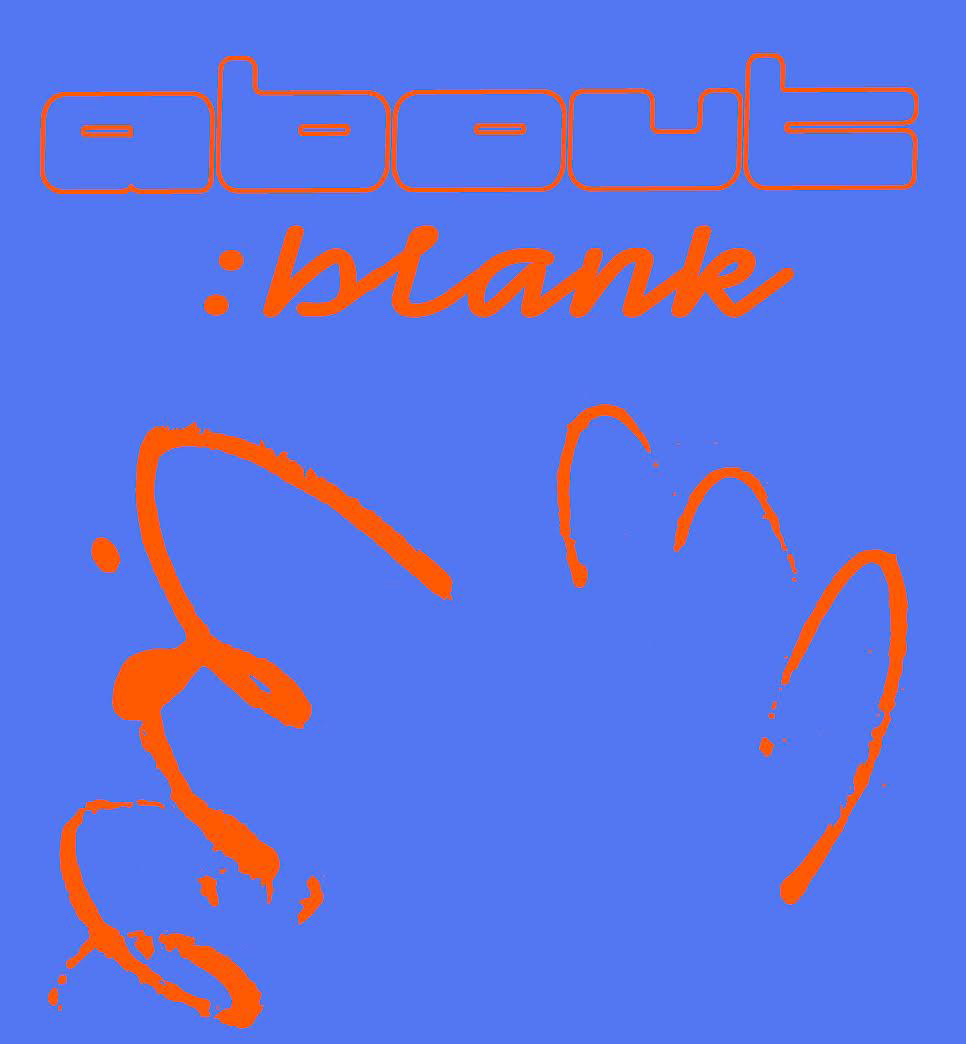
About : Blank
April 10 — May 1, 2026
Clément Dupont — <about:blank>
Looking at Clément Dupont's work for almost ten years now, I see it slide elegantly from his inclination toward painting — carrying as it does the weight of its own History — toward an unconventional blend drawn from the vocabulary of graphic design. A fusion made of subtle back-and-forth movements, which also allows him to bring into his work the studio itself and its trappings, along with typography and its communicative use.
In the new paintings I make out his faithful balance between the comforting motifs of his medium, the late arrival of self-portraiture — with all the complexity that subject carries — and genre scenes, such as the recent series of dogs. I also see how tensions animate him. Clément Dupont allows himself constant learning, notably during his stay in Japan, which reawakened drawing and material through the ancestral tradition of woodblock engraving. The artist questions the multiplicity between art and craft, rigour and love of technique, the will to do things well and digital interaction, the glitch. He claims all these appetites within the contemporaneity of his age and his century.
Calm, patience, slowness, attention — this is how I would describe the almost hypnotic attitude in his way of working, of savouring the layers, pictorial and coloured. I place "the ground" here back at the centre of the village, or how the artist — within a historical continuity of his medium — spends many hours before finalising his grounds. Modestly, the dominant colour comes to neutralise the others. The indefinable, monotone beige of the recent canvases nonetheless carries within it shades of green, pink, yellow, orange and gold (quite a family!). And it is only through the use of glazing and contemplative attention that the eye perceives, and then admits, the plurality of tones, the sometimes biting kick of the underlayers' colours — this mille-feuille within the artist's work.
Clément Dupont integrates images into his painting as much as into his graphic design practice. He accumulates them, collides them, lets them contradict one another. There is in his approach a feverishness in the act of adding images to images. Yet the artist frees himself from documentary weight, accepting the necessity of a model. He does not forget, however, to "put images into circulation, make them transit, disguise them, deform them (...) and play, with full knowledge and pleasure, in, with, against the powers of the image."¹ The pretext photograph, the one that has nothing to say and yet tells stories all the same.
I have little doubt that, behind these visual collisions, the artist has occasionally ventured into Photopolkie — that "popmodern country" as Xavier Domino defines it². Clément Dupont draws from it a living matter, adding to it that of the studio and of chance. He superimposes, glues, and owns visual citations such as the handwritten marks of a Cy Twombly, or the reprise of Ben-Day dots — an identifiable homage to the dear screen of Roy Lichtenstein, magnified by Sigmar Polke, inseparable from Robert Rauschenberg.
Recently — and this is a joy — Clément Dupont has allowed himself to show his gestures. Until now, he had indeed been attached to the invisibility of his touch: oil painting in all that it embraces of the photographic and, I dare add, of the digital. In his latest canvases, the artist ricochets. Wiping his brush becomes an artistic act and no longer merely a studio gesture. From then on, he does it on the canvas that will become the support for the next painting. A continuity and a dissonance in the perception of palettes then come into play. And this accumulation, this collection of raw coloured matter, sits in the foreground and structures the work. The palette becomes a subject in its own right, on a par with the other motifs. The artist speaks of a pangram³, in that the work brings together everything that constitutes painting. The palette, then, with its pure colours and unforeseen mixtures, but also the tools that crumple, staple, trace or blur, the supports that absorb or resist, the accidental traces — splashes, smudges, fingerprints — down to the adhesives that mask, delimit, fill in. Everything is now a stakeholder in the work. Also admitted is this gesture — still too new to know today whether it heralds what follows — when the artist turns the painted canvas over onto its back and frames it anew. Both sides will be exhibited. There is much in Clément Dupont's work, and in parallel, surprisingly, the canvases increasingly welcome space, and emptiness.
<about:blank> Loading error. Empty Breath Silence
Emptiness as potentiality. It has long been known in art that emptiness is not absence, but invitation; a place where anything can happen. I am pleased here to return to Japan with Clément Dupont and to invoke the culture of ma (間) — a principle that structures the perception of the world by balancing presence and absence, fullness and emptiness, sound and silence. This term names the interval, the space or the void between two elements, as much as the distance that naturally exists between objects, or the pause in time between two or more phenomena⁴.
I look, then, at Clément Dupont's canvases, and, on a par with the pangram, I think of the iroha-uta, that poem which uses every syllable of the Japanese syllabary: the white of the ground is never truly silent, it remains charged with everything that has been and everything that is yet to come. Perhaps this is why certain canvases, like certain poems, hold us for so long. They do not merely show — they summarise. They are at once tool, gesture, and what remains — a syllable, a line, a word, a touch of colour, an absence, a continuous breath between emptiness and fullness.
I look at Clément Dupont's works. I fall silent. Four minutes thirty-three.⁵
— Émilie Flory, Manosque, April 2026
Notes 1. Michel Foucault, La Peinture photogénique, 1975. Text written for the exhibition catalogue of Gérard Fromanger's Le désir est partout, published by the Parisian gallery Jeanne Bucher. 2. Xavier Domino, Le photographique chez Polke, Éditions Le point du jour, 2007. 3. A pangram is a short sentence containing every letter of the alphabet. 4. See the definition of Ma in the dictionary of classical Japanese, cited in Isozaki Arata, La notion d'espace-temps au Japon, Musée des Arts décoratifs, 1978. 5. A smile and a knowing wink to John Cage's musical work 4'33'', composed in 1952.
Curator
Émilie Flory
Curator and art critic, member of AICA France, Émilie Flory examines the contemporary regime of images, notably through the many forms of reappropriation that artists deploy today.
A graduate in cultural engineering, she directed the image/imatge contemporary art centre in Orthez from 2001 to the end of 2015, and oversaw its artistic direction until February 2016. After a voluntary year at San Francisco Camerawork, she devoted herself to freelance curatorial projects, in France and internationally. She collaborates with public and private partners, acting as director or head of department within art centres and regional contemporary art funds (FRAC).
In parallel, she initiates and coordinates groups of collectors, overseeing their prospecting and acquisitions. Her expertise also leads her to support institutions and artists in inventory and restoration campaigns for the works in their collections.