
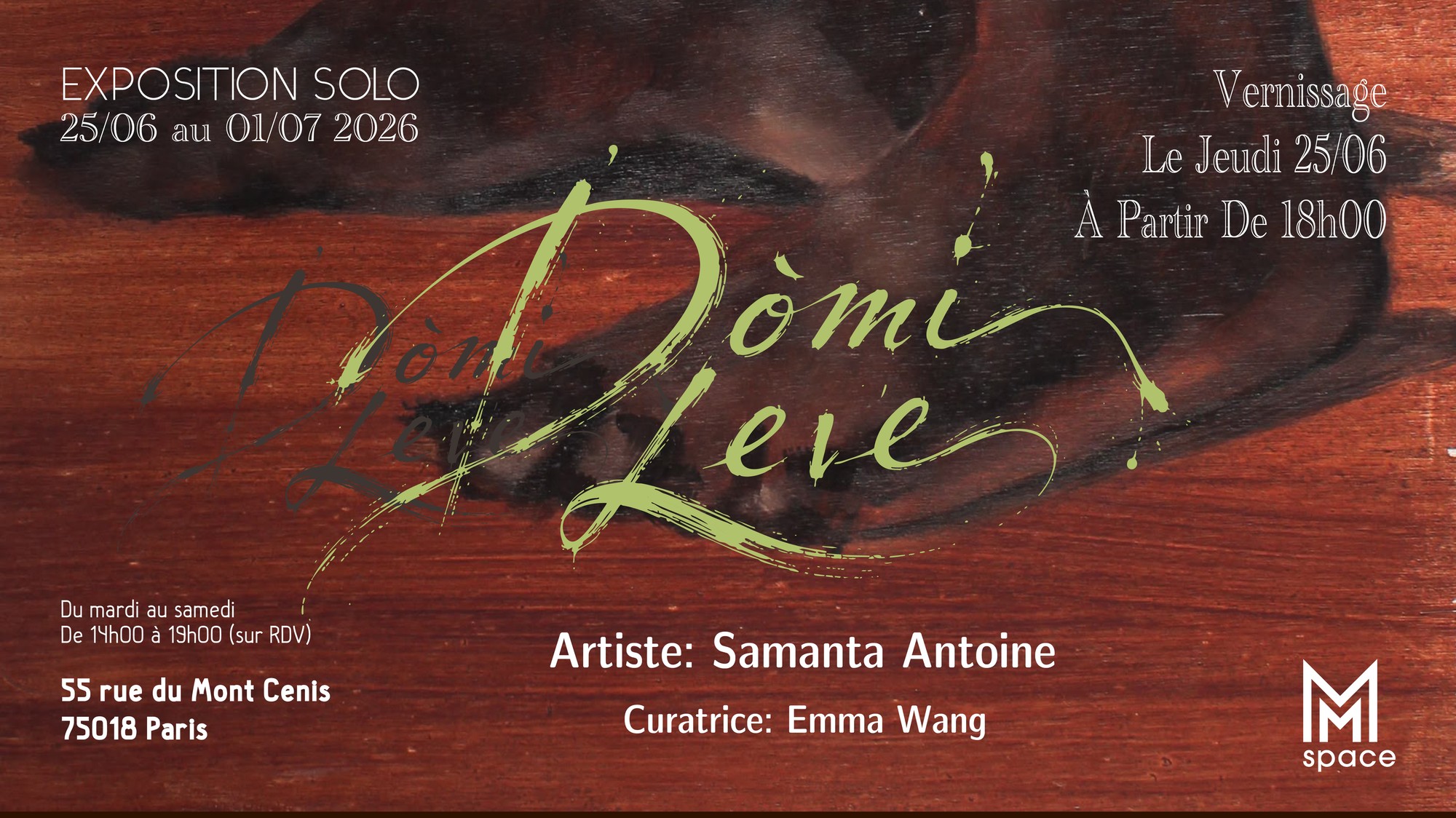
Presented by Samanta Antoine in collaboration with Mspace, Dòmi Leve brings together a new body of work developed during the artist's studies at the Beaux-Arts de Paris. Born in Port-au-Prince (Haïti) and raised in France, Antoine's practice is deeply informed by her cultural heritage and diasporic experience. Working across painting, text, and performance, she explores the intersections of personal and collective, memory and imagination, the visible and the invisible.
The exhibition takes its title, Dòmi Leve ("sleeping awake"), from a state suspended between waking and dreaming. It draws from the concept of Nan Dòmi, described in Haitian Vodou as a state of heightened perception attained through initiation and sustained attention. Neither fully asleep nor fully awake, it is a condition in which the boundaries between the known and unknown worlds become permeable, allowing one to perceive what ordinarily remains unseen. Rather than an escape from reality, Nan Dòmi offers another way of inhabiting it.
Antoine's figures reflect this state. Emerging and receding, blurred, fragmented, or partially obscured, they appear suspended between visibility and disappearance. Their presence suggests forms of knowledge that exceed the material world and resist fixed definition. Women appear throughout Antoine's work as recurring figures. For the artist, they are not merely subjects but guardians, witnesses, and mediators between different worlds. They carry familial and ancestral memories across generations, sustaining connections between people and place, history and the present.
Antoine is interested in the religious ceremonies found throughout Haïti, from Vodou practices to Christian rites, as well as the diverse spiritual traditions that traverse the territory. Her work does not seek to isolate a particular tradition, but rather to examine how beliefs, rituals, and cosmologies have been transformed through the histories of slavery, colonialism, and migration.
Across many Afro-descendant territories, religious practices constitute complex spaces where African inheritances intersect with imposed Western traditions. Far from being simple systems of belief, they can be understood as living archives through which communities have preserved knowledge, memory, and ways of being despite historical violence.
From this perspective, Vodou as it exists today, alongside other religious forms shaped within colonial contexts, may be understood not only as spiritual practices but also as spaces of creativity and revolution. They sustain connections between generations, the living and the departed, while carrying the traces of historical transformations that continue to shape the present.
Reflecting these spiritual foundations that run throughout Antoine's practice, central to the exhibition is the notion of the croisée—a crossing or crossroads. For Antoine, the croisée is both a historical and spiritual condition. It speaks to the entanglement of histories, territories, and systems of knowledge shaped by Haïti's colonial past, while also marking a point of encounter between visible and invisible worlds. Like the state of Nan Dòmi, the crossroads is a place where different realities coexist and where perception expands beyond the limits of ordinary experience. It is less a fixed location than a space of relation, transformation, and exchange.
Between the Dòmi Leve state, the profoundly asleep and the full consciousness of the self, Antoine does not seek to explain the invisible but invites viewers to dwell within it, attending to moments when different worlds briefly converge. In her works, mountains, waters, and bodies compose a sensitive cartography shaped by history, memory, and imagination. Painting becomes a space in which dispersed fragments may enter into relation, where the visible offers a glimpse of what usually remains beyond sight.
Curator
Emma Wang
Emma Wang is a London-based curator and writer whose research centres on mother–daughter relationships, intergenerational care, and diasporic experiences. A graduate of the MFA Curating at Goldsmiths, University of London, and recipient of an Arts Council England Project Grant (2025), she has collaborated with organisations and collectives including Sine Screen, MayDay Rooms, the Feminist Duration Reading Group, and Roarrr Theatre.